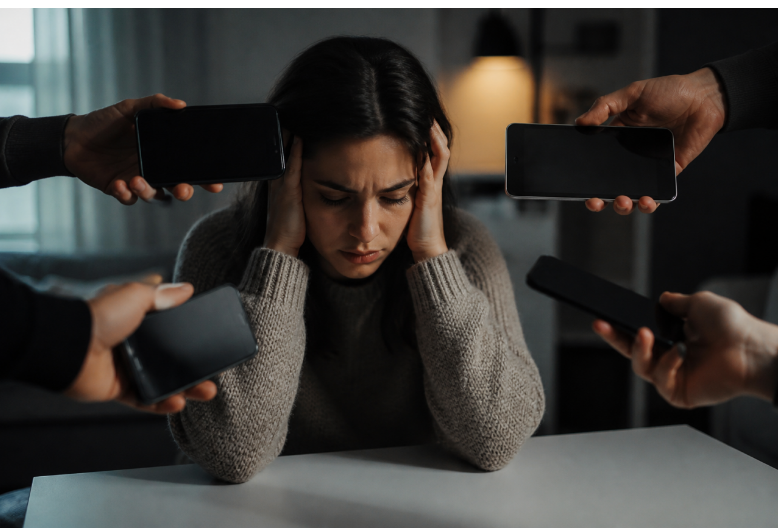
A behavioural addiction, sometimes called a process addiction, is a pattern in which someone feels driven to repeat an activity, whether that is online betting, gaming, scrolling, shopping, watching pornography, exercising, or working, even when part of them wants to cut back and important areas of life are beginning to suffer. The American Society of Addiction Medicine defines addiction as a treatable, chronic medical condition in which people keep repeating behaviours compulsively despite harmful consequences, and that definition fits non-substance behaviours just as fully as it fits drugs or alcohol.
The comparison with substance addiction is useful but needs a little care. Both involve chasing pleasure or relief, losing a sense of control, and carrying on even when the cost is clear. The main practical difference is that one centres on a chemical and the other on an activity, but the underlying brain systems are strikingly similar. Behaviours that feel rewarding trigger the release of dopamine, the same chemical involved in substance addiction, and over time the brain learns to treat the activity as something it cannot easily do without.
The basic loop works like this. A trigger, whether boredom, loneliness, stress, or conflict, sets off an urge. The behaviour delivers short-term relief or excitement, the brain registers that relief as something valuable and files it away, and the next time a similar trigger arrives the urge comes faster and feels stronger. Gradually the behaviour shifts from being a choice to feeling like a necessity, not through any weakness of character, but because that is how habit loops work when they are reinforced often enough.
What makes this particularly tricky is that many of these activities are socially accepted, even admired. Working late suggests dedication. Staying connected online seems normal. Exercising hard reads as healthy discipline. There are no obvious physical signs, so the problem is easy to minimise, both by the person experiencing it and by those around them. If someone performs poorly at work because they were up all night on the internet, the root cause is rarely spotted and the person often continues to suffer in silence.
From Enjoyment to Trap: How Normal Habits Can Slide into Compulsion
The progression usually follows three stages, and most people can locate themselves somewhere on the spectrum if they look honestly.
First comes enjoyment: the behaviour is fun, soothing, or energising, and it genuinely adds something to your day. Then comes reliance: you find yourself turning to it not because you want to but because you need to feel okay, or because skipping it leaves you irritable and unsettled. Finally, compulsion sets in, and the behaviour feels like something you have to do, even when it is causing problems you can see clearly.
A few everyday illustrations make this easier to recognise. Scrolling starts as a quick check of notifications and turns into hours lost most nights, with sleep suffering and the morning beginning already depleted. Gaming shifts from relaxed social play to all-night sessions on weekdays, with work or school paying the price the next day. Online betting begins as an occasional flutter and slowly becomes about chasing losses, with the stakes climbing to recapture the feeling of an early win. Shopping starts as a treat and becomes frequent, secret purchases, with debt mounting and receipts hidden. Even exercise or work, activities most people consider straightforwardly positive, can become rigid and anxiety-driven if they are missed, no longer a source of enjoyment but a compulsion that leaves no room for flexibility.
The common thread across all of these is emotional regulation. The behaviour becomes the main tool for managing anxiety, numbing difficult feelings, avoiding conflict, or filling loneliness, and once it is doing that job the pull becomes much harder to resist, because stopping means sitting with the very feelings the behaviour was covering up.
Enjoying a hobby intensely, training hard for a goal, or spending a lot of time on something you genuinely love is not the same as addiction. The key question is not how much time you spend but what happens to your freedom of choice and to the rest of your life around it.
Red Flags: Signs a Habit May Have Crossed into Behavioural Addiction
The following questions are not a formal diagnosis, but they reflect the signs clinicians and researchers consistently identify. Read through them honestly, perhaps more than once.
- Do I often spend more time or money on this than I planned?
- Have I tried to cut back and found I cannot stick to it?
- Do I need more, more time, more intensity, more money, more risk, to get the same buzz or sense of relief I used to get?
- Has my work, sleep, health, finances, or a close relationship suffered as a result of this behaviour?
- Do I keep going even when part of me knows it is hurting me or people I care about?
- Do I feel restless, low, irritable, or simply not myself when I cannot do it?
- Have I started hiding, deleting, lying, or minimising how often I engage in it?
- Has this become my main way to cope with stress, numb out, or escape feelings I do not want to face?
- Have I lost interest in other hobbies, people, or responsibilities I used to care about?
If several of these feel uncomfortably familiar, the behaviour may be functioning like an addiction, regardless of whether it involves a substance or whether anyone else has noticed. Ticking most of the boxes does not make you an addict in some fixed, shameful sense. It means the pattern has likely moved beyond a habit, and understanding that clearly is the first step towards doing something about it.
Red Flags: Signs a Habit May Have Crossed into Behavioural Addiction
First Steps to Loosen the Grip Without Relying on Willpower Alone
Trying to simply stop through force of will usually backfires. It focuses all attention on restriction, tends to deepen shame when it fails, and does nothing to address the triggers or emotions keeping the cycle in place. A more useful starting point is curiosity rather than control.
Begin with observation. For one to two weeks, keep a short private log: when you engaged in the behaviour, how long it lasted, what was happening just before (your situation, mood, thoughts), and how you felt afterwards. Patterns tend to become visible quickly. You might notice the urge spikes when you are lonely at the end of the day, after a difficult conversation, or when a particular app is the first thing you reach for. That information is genuinely useful, because it tells you what you are actually trying to manage.
From there, experiment with gentle limits rather than all-or-nothing rules. Set a specific time boundary, a session cap, or a financial limit, and pay close attention to how easy or difficult it is to hold. The difficulty itself is informative: where you feel the most resistance is usually where the behaviour is doing the most emotional work.
Alongside limits, build alternative responses to your key triggers. A short walk, a few minutes of slow breathing, texting someone you trust, a different hobby, music, or a brief stretching routine can all interrupt the automatic move towards the compulsive behaviour. None of these need to be dramatic; the aim is simply to create a small pause between the trigger and the response, which is often enough to change the outcome.
Sharing what is happening with one supportive person also matters more than it might seem. Compulsive behaviours tend to thrive in secrecy, so telling someone you trust, adjusting a shared routine at home, or asking a partner to help create a tech-free space in the evenings can shift the environment in ways that willpower alone cannot. Setbacks are normal when experimenting with change, and they are not failures. They are information about what the pattern still needs from you.
Knowing When to Reach Out and What Getting Better Actually Looks Like
Self-help strategies are a genuine starting point, but there are clear signs they are not sufficient on their own. If the behaviour continues to damage your mental health, relationships, work, or finances despite genuine attempts to rein it in; if the risk level is escalating through mounting debts, unsafe decisions, or neglected physical health; or if you keep cycling through short-lived resolve followed by relapse, it is time to bring in professional support. That is not a sign of having failed. It is a sign of taking the situation seriously.
The same applies if there are co-existing difficulties such as persistent anxiety or depression, thoughts of self-harm, or substance use alongside the behaviour. These layers rarely untangle themselves without structured help, and trying to manage everything alone can make each problem harder to shift.
What professional support can offer is qualitatively different from self-help. Structured approaches such as cognitive-behavioural therapy work directly on the thought patterns and emotional triggers that sustain the cycle. A skilled therapist provides a non-judgemental space to understand why the behaviour took hold, what it has been protecting you from, and how to build genuinely different ways of coping. That understanding is what makes change last, rather than simply suppressing the behaviour until stress tips you back into it.
Calm Rehab specialises in exactly this kind of non-substance addiction support, and what you need to know about non-substance addiction goes deeper into the science covered here and sets out clearly what assessment and structured programmes can involve, making it a useful next step for anyone who recognises themselves in this article.
It is also worth reframing what recovery actually means, because the picture most people carry is inaccurate. Recovery from a compulsive pattern is not about giving up pleasure, being monitored indefinitely, or swearing off an activity entirely. It is about regaining genuine freedom of choice, so that you can engage with the things that matter to you in a way that fits a balanced life rather than consuming it. Lapses along the way are a normal part of the process, not proof that change is impossible.
The most useful thing you can do today is pick one small, concrete action and follow through: answer the nine questions above honestly, start a two-week behaviour log, tell one person what has been going on, or spend fifteen minutes reading through Calm Rehab’s resources on process addiction. You do not need to have the whole answer yet. You just need to take one step that puts you back in the driving seat See more:wutawhealth.org